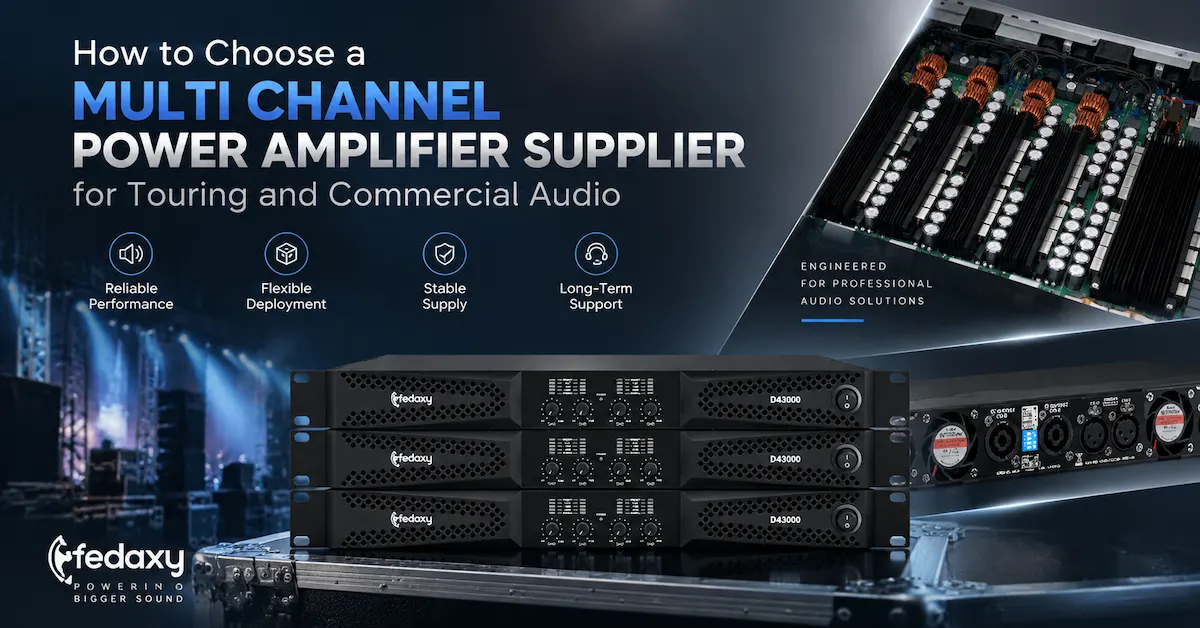
Introduction: why supplier choice changes system reliability
A four-channel chassis can look economical on a quotation and expensive after installation. One channel may feed a pair of front fills, another a subwoofer circuit, while the remaining two drive mains. Those outputs do not impose the same current demand or require the same limiter setting. In a closed equipment rack, the combination also changes heat and fan behavior. A supplier who reads the channel schedule can catch a questionable parallel connection before equipment ships; a wattage-only quote cannot.
For integrators, choosing a multi channel amplifier manufacturer is therefore a design and risk decision. The purchase affects the number of rack units, the electrical service, the number of spares, the commissioning workflow and the consistency of future batches. Rental companies add transport and setup speed. Distributors add documentation, replacement parts and private-label support. Commercial audio contractors add acoustic coverage and handover obligations.
This article answers three related questions. First, what technical evidence should a buyer request? Second, how should channel count, impedance and application affect the shortlist? Third, what should a supplier prove before a buyer commits to an OEM or production order? The product examples link to CS-AUDIO public pages, while all final power, voltage, certification and commercial terms should be confirmed against the current model revision.
What is a multi channel power amplifier supplier?
A multi channel power amplifier supplier provides one or more amplifier platforms that contain multiple independent output channels in a shared chassis or product family. The supplier may be a factory, an engineering-led manufacturer, a distributor or a combination of these. The important distinction is not the label. It is whether the supplier can connect a published specification to the actual loads, controls, installation conditions and support obligations of a project.
A professional platform normally includes an input stage, gain controls or sensitivity settings, power supply, output stage, protection circuits, cooling system, connectors and a mechanical enclosure. Depending on the family, it may use Class D, Class TD, Class H or Class AB topology. It may also integrate DSP or rely on an external system processor. Four channels do not automatically mean that all four channels can deliver the headline number at every impedance for an unlimited duration. The test condition matters.
For a buyer, the supplier's job is to explain the boundary conditions. That includes continuous versus burst power, all-channel-driven behavior, minimum impedance, bridge restrictions, mains voltage, thermal derating, airflow direction and the recommended cabinet count per output. A supplier that documents those boundaries helps the integrator design a repeatable system.
Who needs a professional multi channel power amplifier?
Touring and rental companies
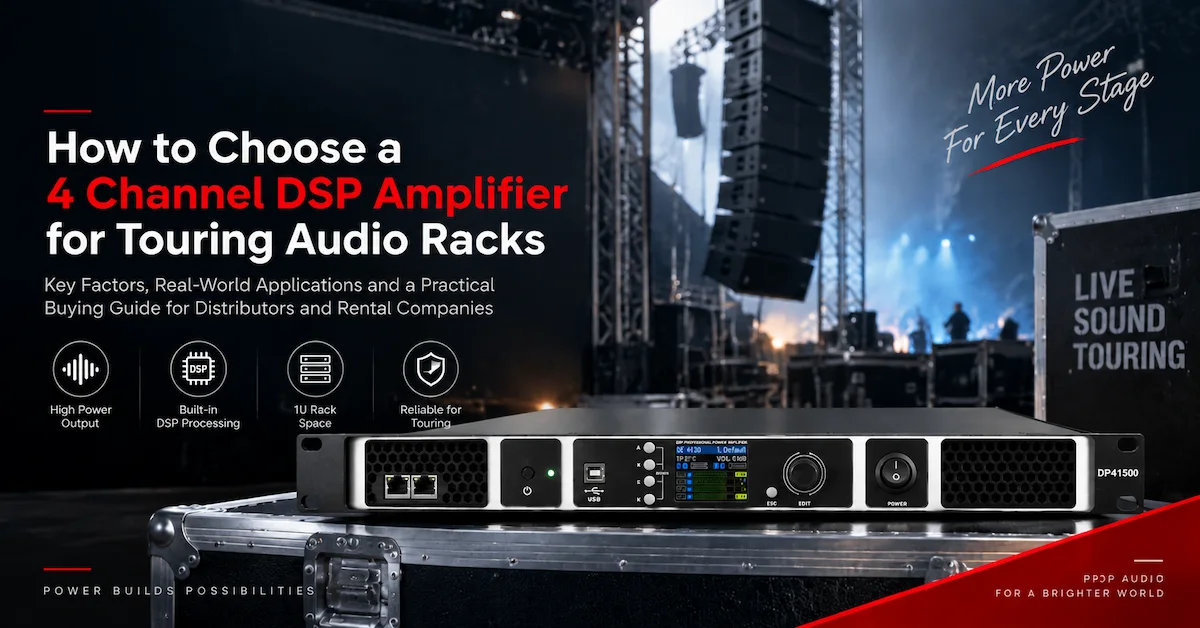
A touring multi channel power amplifier should deliver useful output per rack unit, survive frequent transport, use clear indicators and provide front-to-back airflow when racks are loaded in a row. Rental teams also need fast visual checks, predictable connectors and a spare strategy that works across different productions.
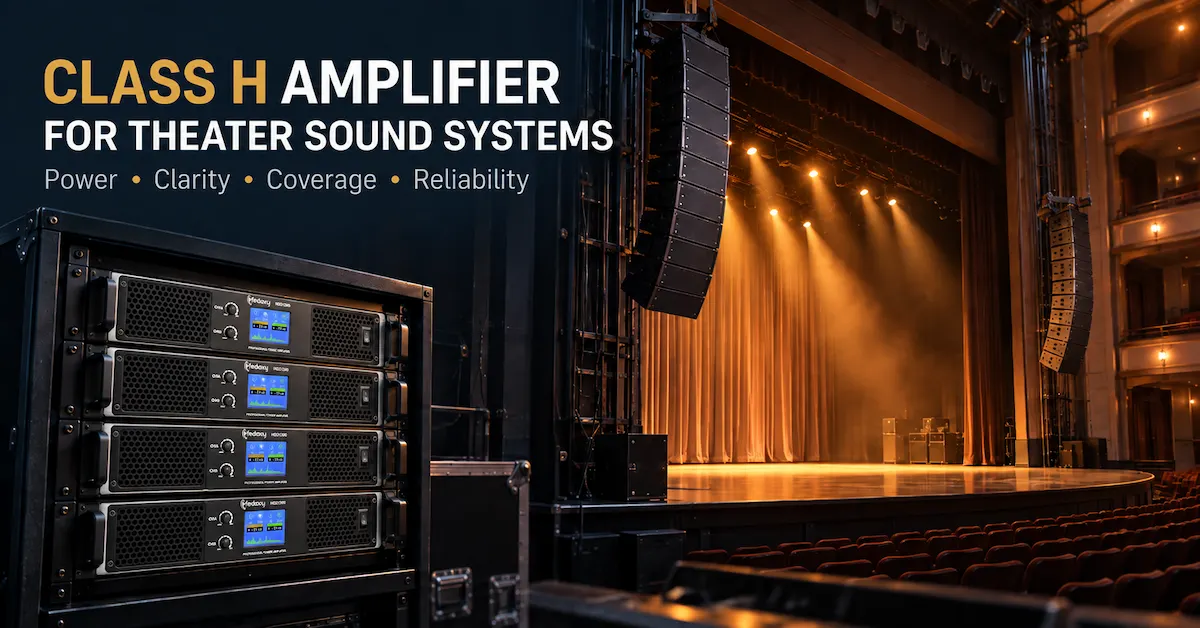
Theaters and cinema integrators
Theater systems may need separate screen channels, fills, surrounds and low-frequency zones. Four-channel models can reduce chassis count, but the channel map, gain structure, limiter settings and fan noise still need to be documented for the room.
Commercial audio contractors
A commercial audio power amplifier supplier should support mixed projects such as conference venues, houses of worship, hotels and multi-function halls. These buyers often value reliable installation data, consistent batches and service parts as much as maximum output.
Distributors and OEM brands
Distributors need a stable product family, accurate files, packing information, warranty terms and a response process. An OEM multi channel power amplifier manufacturer should also explain which customizations are cosmetic and which require electrical or safety revalidation.
The product is not automatically right for every application. A small speech system may be better served by a compact two-channel amplifier. A large touring rig may need high-current four-channel units, spare chassis and consistent presets. Start with the load schedule and operating environment.
How to compare a multi channel power amplifier supplier
1. Ask for power ratings with complete conditions
Put the test conditions beside every wattage figure in your comparison sheet. A 1,200 W/channel claim tells the engineer little if one vendor measured a brief 1 kHz burst into 4 ohms and another published a wider-band result with all outputs working. The measurement categories described in IEC 60268-3 are a useful prompt for this conversation, though the exact test protocol still belongs on the supplier's report.
Request separate 8-, 4- and 2-ohm rows and write “not approved” where an operating mode is unavailable. Record the bandwidth, distortion threshold, time window and number of active channels beside each row. If a headline and parameter table disagree, attach both page versions to the RFQ and ask for the signed current specification. This matters more than arguing over which number looks plausible.
2. Evaluate impedance and current capability
A loudspeaker's nominal impedance is not a fixed resistance at every frequency. Two nominal 8-ohm boxes in parallel are a nominal 4-ohm circuit, but the actual impedance curve can dip below that label. Cable resistance adds loss, not a useful safety margin. A low impedance multi channel amplifier belongs on the shortlist only after the cabinet count, duty cycle and cooling path are known.
For a proposed 2-ohm circuit, ask whether the rating applies simultaneously to all outputs, whether the rack is allowed to run at that load for the expected show duration and what happens as the unit heats. Check the bridge-mode wiring diagram separately. Bridging is not a way to evade a channel's minimum-load rule.
3. Match channel count to the zone map
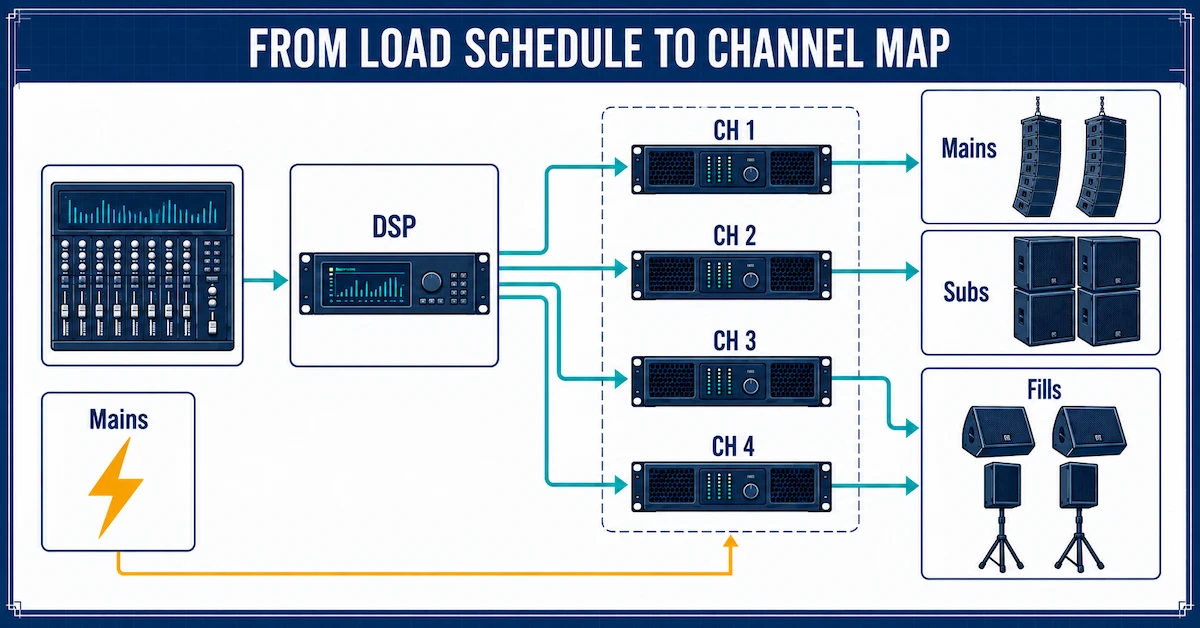
A 4 channel power amplifier supplier can help simplify systems with left, center, right and fill zones, or with multiple subwoofer and monitor feeds. Four channels can reduce rack units and patching, but they also require clear labels, consistent gain and a plan for what happens if one channel enters protection.
Two-channel models remain useful for stereo mains, monitor pairs, dedicated subwoofer pairs and small systems. Three-channel variants can suit a main-main-sub arrangement. The right channel count is the one that preserves independent processing and service boundaries without creating unused capacity that adds cost and heat.
4. Check thermal design and fan behavior
Racks are thermal systems. Ask about fan direction, fan control, intake clearance, exhaust temperature, filter access and derating. A front-to-back design can be easier to integrate into a touring or fixed rack, but only when the rack has a clear inlet and outlet path. A stage-side amplifier also needs a noise check during quiet passages.
5. Confirm protection and recovery
Power-on delay, output DC, short-circuit, overload and over-temperature protection are practical requirements. The supplier should explain what the operator sees, whether a channel recovers automatically and whether service staff can identify the event. Protection should prevent damage without becoming an unexplained interruption during a show.
6. Review connectors, controls and documentation
Confirm input and output connectors, pinout, gain or sensitivity range, bridge mode, indicator meanings, rack dimensions and power-cable requirements. Request a manual, dimensional drawing, data sheet, test report template and packing information. A distributor cannot support installers with a screenshot and a product title alone.
Technology choices: Class D, Class TD, Class H and Class AB
Topology is relevant, but it should not be used as a shortcut for system quality. Class D designs can offer high power density and efficient rack use. Class TD combines switching and linear behavior in a way that some manufacturers use for touring and high-output applications. Class H changes supply rails as signal demand changes and can be used for high-output systems. Class AB remains common in applications where its operating behavior and service familiarity are valued.
Ask the supplier to connect the topology to the installation. What is the expected heat at the target load? What is the fan profile? What is the current capability? How are distortion, noise and damping factor measured? What protection is available? The buyer should select the platform that meets the load and workflow rather than buying a topology label in isolation.
CS-AUDIO's public catalog includes Class D, Class TD, Class H and Class AB families. A project may use different families for different zones: a high-output Class H or Class TD platform for subwoofers, a compact Class D model for fills, or a consistent multi-channel family for a rental fleet. The final choice depends on the loudspeaker schedule and the supplier's written recommendation.
Applications and buyer priorities
| Application | Typical amplifier priorities | Supplier evidence to request |
|---|---|---|
| Touring line arrays | Output per rack unit, front-to-back cooling, transport durability, fast patching | All-channel power table, rack drawing, connector pinout, spare-parts plan |
| Theater and cinema | Quiet operation, independent zones, repeatable gain, protection and service access | Noise guidance, channel map example, limiter workflow, maintenance instructions |
| House of worship | Speech clarity, flexible routing, simple operator controls, long-term support | Input sensitivity, protection behavior, warranty scope, training material |
| Hotel and conference audio | Moderate power, compact rack, predictable heat, integration with DSP | Dimensions, thermal notes, control compatibility, documentation revisions |
| Commercial installation | Consistent batches, delivery planning, certification and spare availability | QC records, certificate scope, packing, lead time and replacement process |
Application language must not replace engineering language. “For touring” does not specify the number of cabinets per channel. “For cinema” does not specify the required headroom. Use the application to identify risks, then use the load schedule to select the model.
CS-AUDIO models to include in a multi-channel shortlist
The following pages are useful starting points for a project comparison. They are linked to the product pages so a buyer can review the current listing, then request the matching data sheet before a purchase decision.
| Product | Published positioning | Potential use in a multi-channel system | Link |
|---|---|---|---|
| D43000 | 1U, 4-channel Class D, 4 x 3000 W headline | High-density touring racks; scrutinize power and cooling at the intended load. | View D43000 |
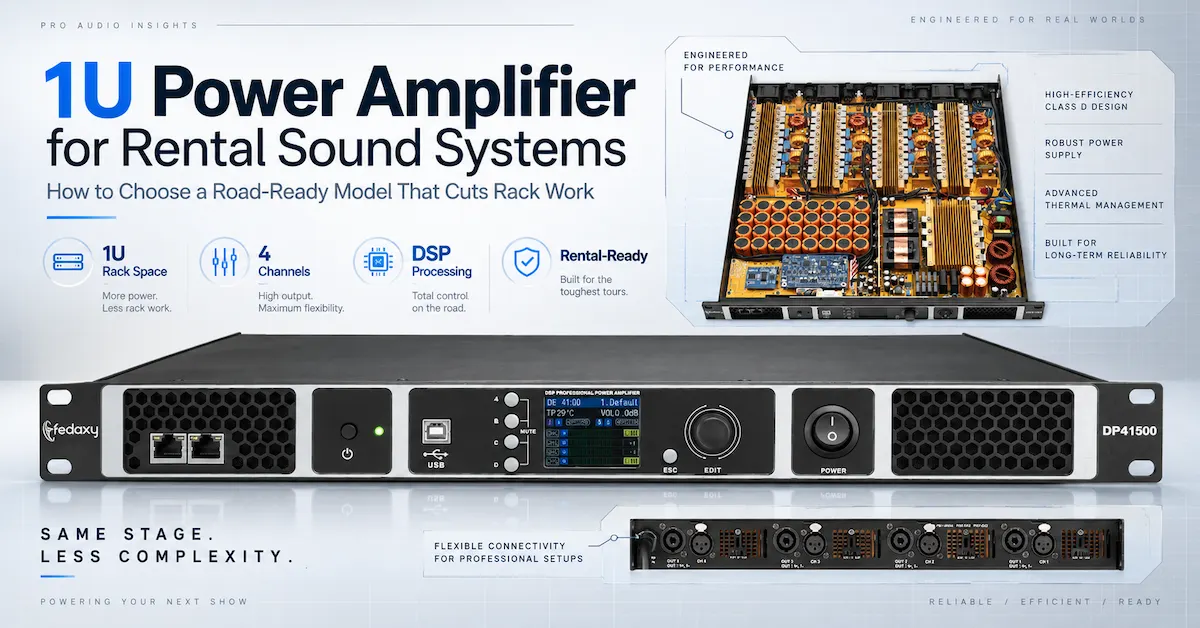
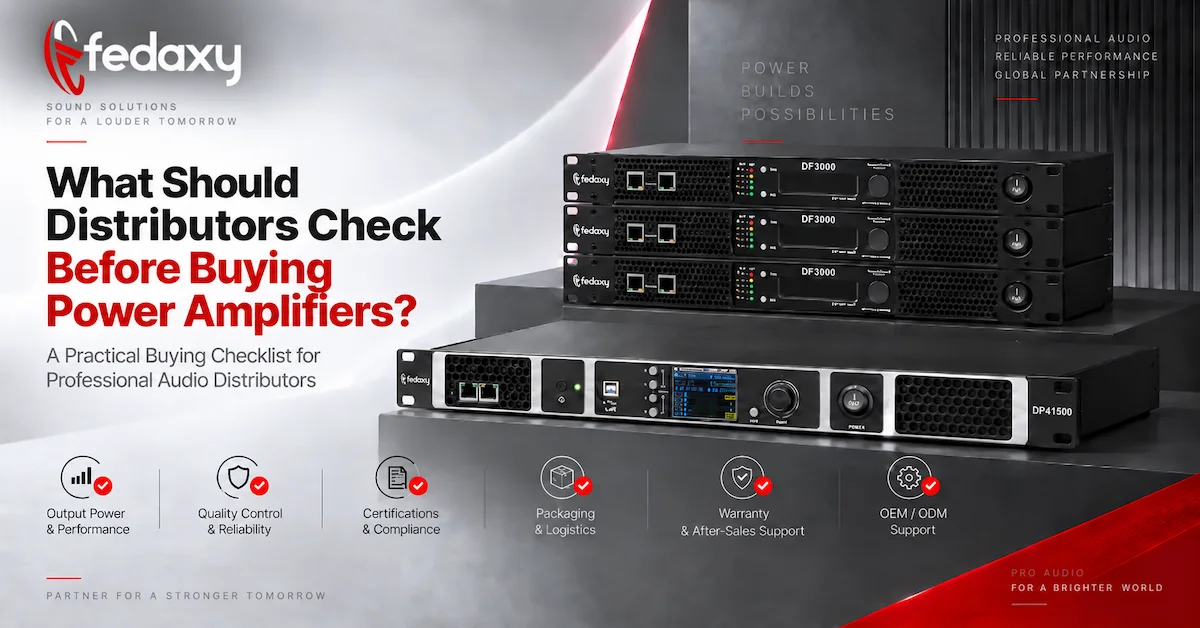
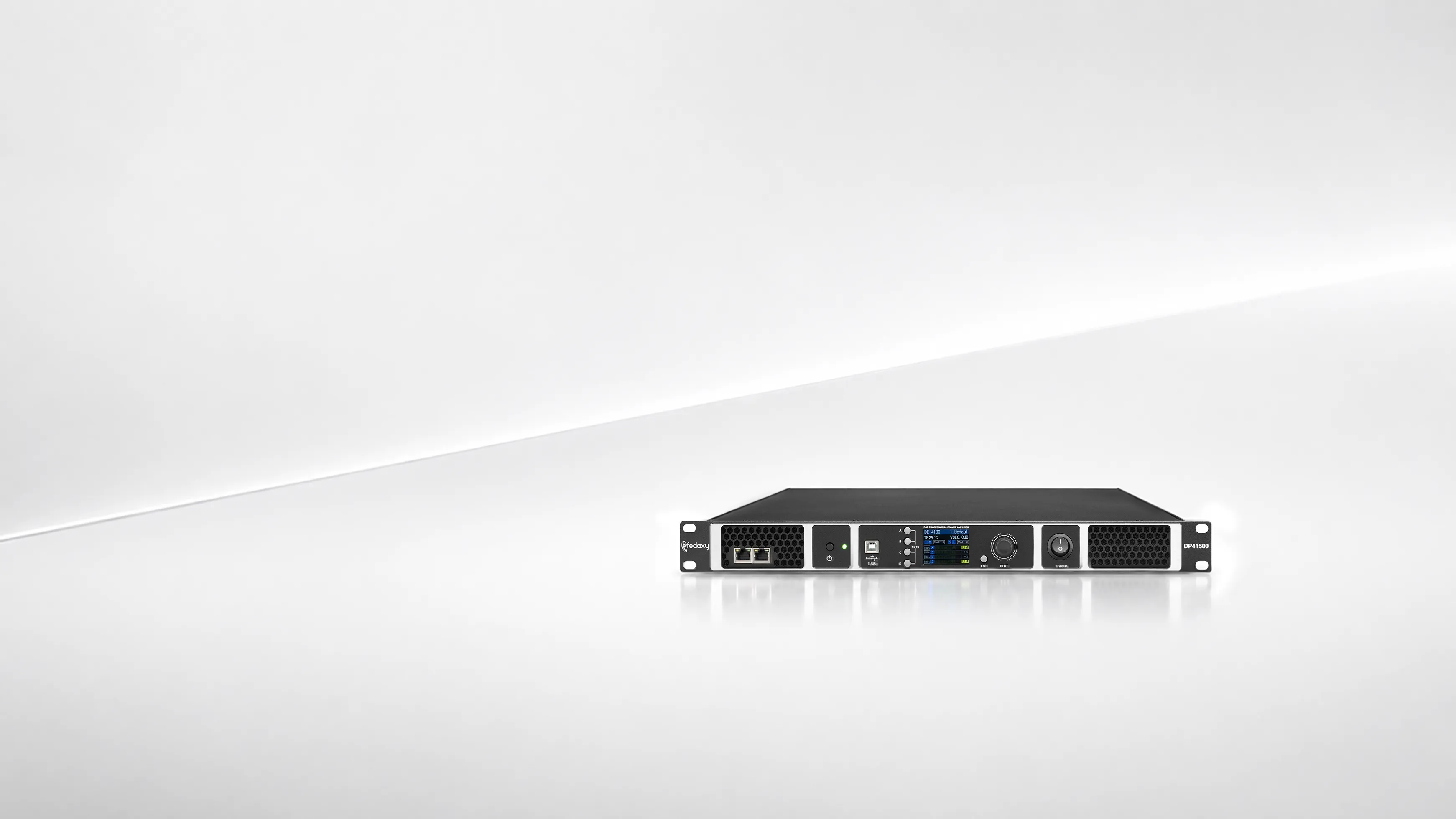
| DP41500 | 1U, 4-channel Class TD with DSP, 4 x 1500 W headline | Racks that need per-channel processing and compact height. | View DP41500 |
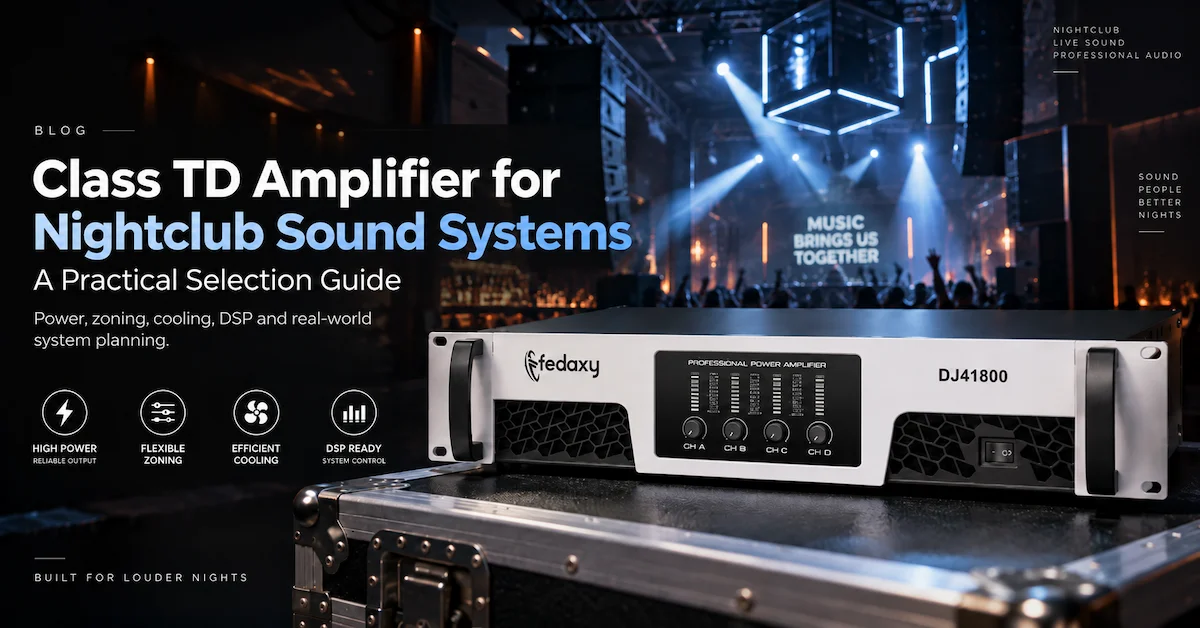
| TD41600 | 2U, 4-channel Class TD, 4 x 1600 W at 8 ohms published | Line-array and touring proposals where transformer-based supply and 2U layout fit. | View TD41600 |
| FH41500 | 3U, 4-channel Class H, 4 x 1500 W at 8 ohms published | High-output mains, larger venues and low-frequency zones. | View FH41500 |
| FC41200 | 4-channel Class H, 4 x 1200 W headline at 8 ohms | Fixed or rental projects; resolve the page's conflicting 4- and 2-ohm figures. | View FC41200 |
| HD21200 | 2-channel, 2 x 1200 W family | Two-channel reference for stereo mains, monitors or dedicated subwoofer feeds. | View HD21200 |
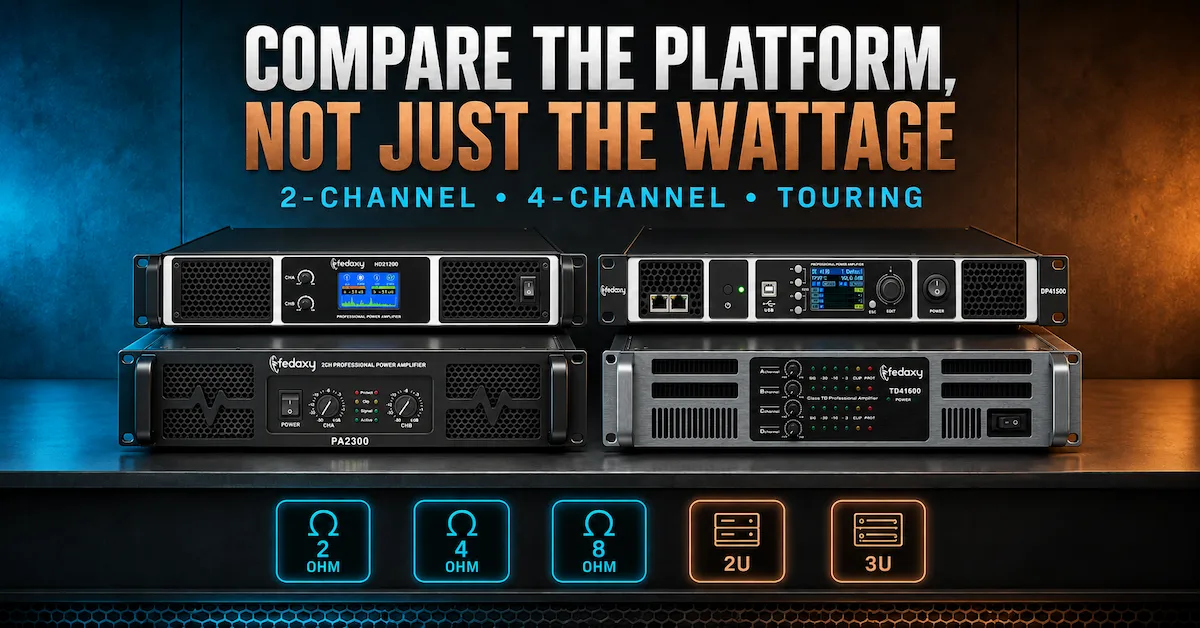
The table deliberately spans three topologies. CS-AUDIO publishes a 1U chassis for both D43000 and DP41500, a 2U chassis for TD41600, and a 3U chassis for FH41500. A fleet manager can therefore compare weight, heat and service access as well as watts per channel. FH41500's page lists 4 x 1500 W at 8 ohms, 4 x 2250 W at 4 ohms and 4 x 3750 W at 2 ohms; ask how those tests were run before using them in a tender. FC41200 needs special attention because its headline and detailed table disagree at 4 and 2 ohms. Obtain the current signed data sheet.
How to audit a multi channel amplifier manufacturer
Evidence of engineering and production control
A credible supplier should be able to show how a design moves from schematic and sample to production and final inspection. Ask about incoming inspection, PCB assembly, wiring, torque control, grounding, burn-in, performance testing and final packing. You do not need proprietary drawings, but you do need enough evidence to understand what is controlled and what is left to operator judgment.
CS-AUDIO publicly describes more than 15 years of R&D and production experience, five QC inspections and an eight-hour aging test. These are public company claims and should be confirmed for the exact model, order and market. Ask whether the aging test is performed at a stated load, whether a test record accompanies the batch and how failed units are handled.
Certification and compliance boundaries
Ask which certificate or declaration applies to the exact model and destination market. Company-level references to ISO9001, CE, RoHS or CB are not a substitute for model-specific documents. Request certificate numbers, scope, revision and expiry where applicable. For electrical safety, compare the model's declaration or report with the applicable edition of IEC 62368-1. That document cannot tell you whether a particular rack sounds good or survives a touring season.
Documentation and traceability
Put the model suffix and supply voltage on the purchase order, not only on an email thread. The file set should include the connector drawing, performance table, operating manual, carton dimensions and warranty terms that match that suffix. Six months later, when an installer calls about a replacement unit, the distributor should be able to locate the matching document by serial range. A folder of unversioned PDFs makes that call needlessly long.
Service, spares and communication
Before the first shipment, walk through a plausible failure: channel three mutes during a weekend show, the operator swaps a spare, and the distributor sends a fault report on Monday. Who performs diagnosis? Is the whole chassis shipped back, or can a trained local technician replace a module? Who pays freight, and what evidence is required? CS-AUDIO's public three-year warranty statement is a starting point; the quotation should spell out the route, exclusions and parts availability for the destination market.
OEM and private-label requirements
An OEM project may involve more than a logo. Buyers may request a custom front panel, packaging, connectors, voltage, firmware or DSP preset. Separate cosmetic changes from electrical changes at the start. A label change may be low risk; a new connector, power supply or protection threshold can require engineering review, sample testing and updated compliance files.
Use a staged approval process. First approve the electrical specification and load limits. Then approve drawings for panel, connector and label details. Next approve a production sample, packing test and inspection plan. Finally, attach the approved revision to the purchase order. This prevents a later batch from being built from an informal message or an outdated PDF.
For an OEM multi channel power amplifier manufacturer project, ask who owns the DSP preset, how configuration files are backed up and whether the private-label buyer receives neutral test documents. A distributor needs credible information for installers without losing the traceability of the underlying model.
Cost, lead time and procurement risk
The unit price is only one part of total cost. Include rack space, shipping weight, insurance, customs, cable looms, DSP programming, commissioning, spare units and regional service. A four-channel chassis may reduce rack count but increase heat concentration. A high-power model may reduce the number of amplifiers but increase electrical demand and transport weight.
Ask for sample pricing, MOQ, production lead time, packing size, gross weight, payment terms and Incoterms in the same RFQ. If a figure is not confirmed, mark it as to be confirmed. Do not copy a generic website promise into a customer tender. A clean comparison sheet has one column for public information, one for project confirmation and one for open risk.
| RFQ field | Buyer provides | Supplier returns |
|---|---|---|
| Application | Touring, cinema, theater, commercial installation or rental | Recommended family and application limits |
| Loudspeaker load | Model, quantity, nominal/minimum impedance and power | Cabinet count per channel and wiring guidance |
| Channel plan | Mains, fills, subs, monitors, surrounds and spares | Channel map, bridge limits and gain notes |
| Rack and power | U height, depth, airflow, voltage and frequency | Dimensions, cooling direction and supply requirements |
| Commercial terms | Quantity, destination, target date and branding | MOQ, sample, lead time, packing, warranty and spares |
Commissioning checklist for a multi-channel amplifier system
- Verify paperwork: match model, serial range, voltage, manual revision and current data sheet.
- Inspect the rack: confirm rails, airflow, cable bend radius, grounding and service clearance.
- Label every channel: connect processor output, amplifier input, amplifier output and speaker zone in one map.
- Confirm impedance: check polarity, parallel wiring, expected load and any bridge condition before applying program.
- Set gain structure: align processor output, amplifier sensitivity and limiter thresholds.
- Test at working level: observe temperature, fan behavior, indicators, noise and channel balance.
- Verify protection: follow the manual's safe procedure for overload, short circuit and output DC behavior.
- Document handover: save presets, channel maps, measured values, maintenance intervals and emergency contacts.
What to send for a fast quotation
The shortest path to a useful recommendation is a complete brief. Include:
- venue or application type and whether the system is fixed, touring or rental;
- speaker brand, model, quantity, nominal impedance, minimum impedance and continuous/program power;
- zone list: left, center, right, fills, subs, monitors, surrounds, lobby or background audio;
- desired channel allocation, bridge requirements and any 2-ohm operation;
- mains voltage, frequency, rack height, maximum depth, airflow and ambient temperature;
- DSP, Dante, analog input, remote monitoring, connector and preset requirements;
- delivery country, target quantity, sample need, private-label scope, target date and service expectations.
With this information, the supplier can recommend a platform instead of sending a generic catalog. The response should state the model, expected load, output condition, channel map, assumptions, open questions and the documents supplied. That format helps an integrator compare vendors on evidence rather than sales language.
FAQ: multi-channel power amplifier supplier questions
- What should a buyer examine first when comparing suppliers?
- Begin with one real channel of the project. Send its loudspeaker count, impedance curve and target level; ask each vendor to return the amplifier model, approved wiring, headroom assumption and test conditions. A catalog-only reply leaves the most important questions unanswered.
- When does four-channel hardware make sense?
- It can save rack space when four zones need independent processing and similar service access. A stereo main pair plus a separately maintained subwoofer rack may be simpler with two-channel chassis. Draw the patch and spare plan before counting units.
- Is 2-ohm operation available on every output?
- Do not infer that from one line of a catalog. Ask whether all four outputs can work at the published 2-ohm condition in the proposed ambient temperature and for the expected show duration. Also check the loudspeaker's minimum impedance, not only its nominal label.
- How do I compare a high power multi channel amplifier?
- Use a side-by-side sheet with load, bandwidth, distortion, test duration and active channel count. Add chassis height, shipping weight, power draw, cooling path and service parts. The apparently stronger model may not fit the electrical room.
- What does a reliable 4 channel power amplifier supplier provide?
- At minimum, ask for the current manual and dimensional drawing, a conditioned output table, a connector pinout and a written response to your channel schedule. Ask how a protection event is diagnosed after installation.
- What belongs in an amplifier RFQ?
- Attach the venue plan and loudspeaker schedule. Mark which channels are mains, subs or fills; list voltage, rack depth, airflow and DSP requirements; state the destination, quantity, private-label work and required delivery window.
- How should an OEM buyer approve changes?
- Approve the electrical base model first. Treat panel artwork, carton, connectors and firmware as separate revisions, and require a new sample or compliance review whenever a change touches electrical behavior or safety.
- What if a product page disagrees with its specification table?
- Save both versions, ask the factory to identify the correct current revision and put the agreed rating in the quotation. Do not build a tender around the larger of two unverified figures.
Conclusion: select the evidence, then select the amplifier
The right multi channel power amplifier supplier is not simply the supplier with the largest number on a product page. It is the supplier that can connect output power, impedance, channel count, thermal behavior, protection and service to your real loudspeaker schedule. Start with the zones. Compare like-for-like ratings. Confirm rack and mains conditions. Then record every assumption in the quotation.
CS-AUDIO's public catalog offers a practical first comparison: D43000 for a compact Class D rack, DP41500 where integrated DSP is part of the brief, TD41600 for a 2U Class TD option, and FH41500 or FC41200 for Class H. Keep the comparison conditional. The same nominal power class can have a different chassis height, supply architecture, control workflow and service profile. Ask CS-AUDIO to identify which model it would actually put on each line of your channel schedule, with the supporting data sheet.
Send your venue, speaker model, impedance, quantity, channel map, voltage, rack constraints and branding requirements. A project-matched review gives your team a recommendation it can test, quote, install and support.