Introduction: why theater amplification deserves a design brief
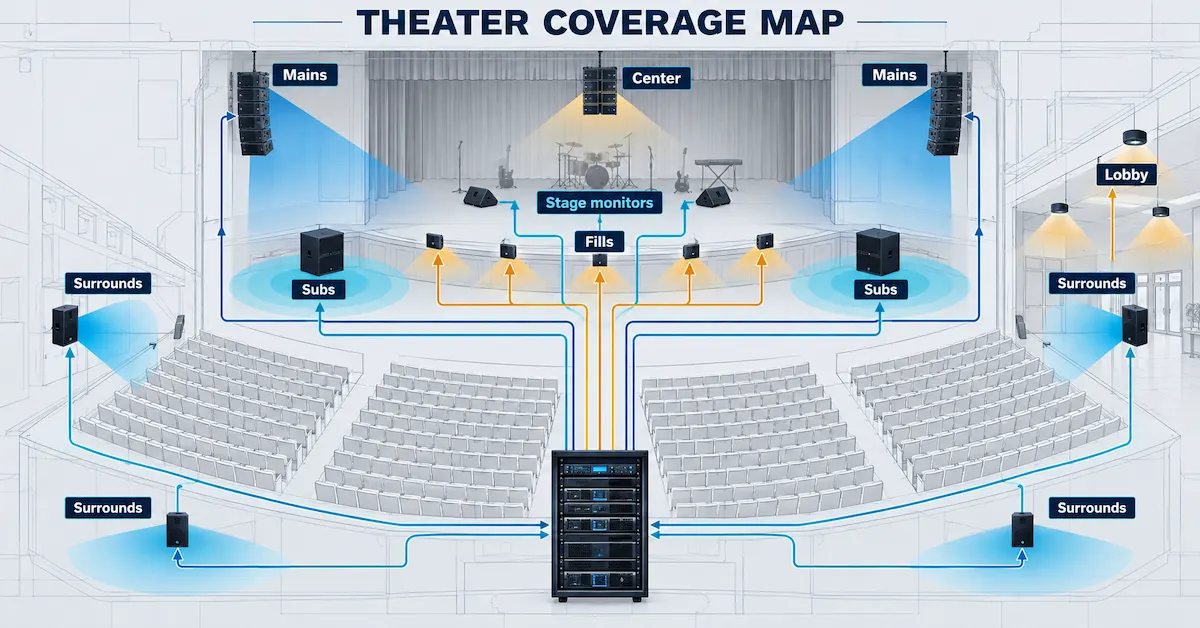
A theater is not a single loudspeaker stack. A typical room may have left, center and right screen channels, front fills under the stage, side and rear surrounds, one or more subwoofer arrays, stage monitors, lobby feeds and assistive-listening outputs. Each zone has a different acoustic job. A power amplifier that is comfortable on a short demonstration may be a poor choice when it must run every show, in a closed rack, with several low-impedance cabinets connected.
That is why a purchasing team should treat an amplifier as part of the system design, not as a wattage item selected from a marketplace filter. The right theater sound system power amplifier gives the loudspeaker enough voltage and current, preserves transient headroom, remains predictable as the load changes and provides protection when a cable, connector or cabinet fails. It also fits the room's equipment plan and the service team's workflow.
This article is written for theater owners, cinema integrators, stage-technology contractors, rental companies, distributors and OEM buyers. It addresses information, comparison and quotation intent in one place. The figures quoted for CS-AUDIO models are public product-page figures; confirm the current revision, test conditions, voltage and commercial terms before placing an order.
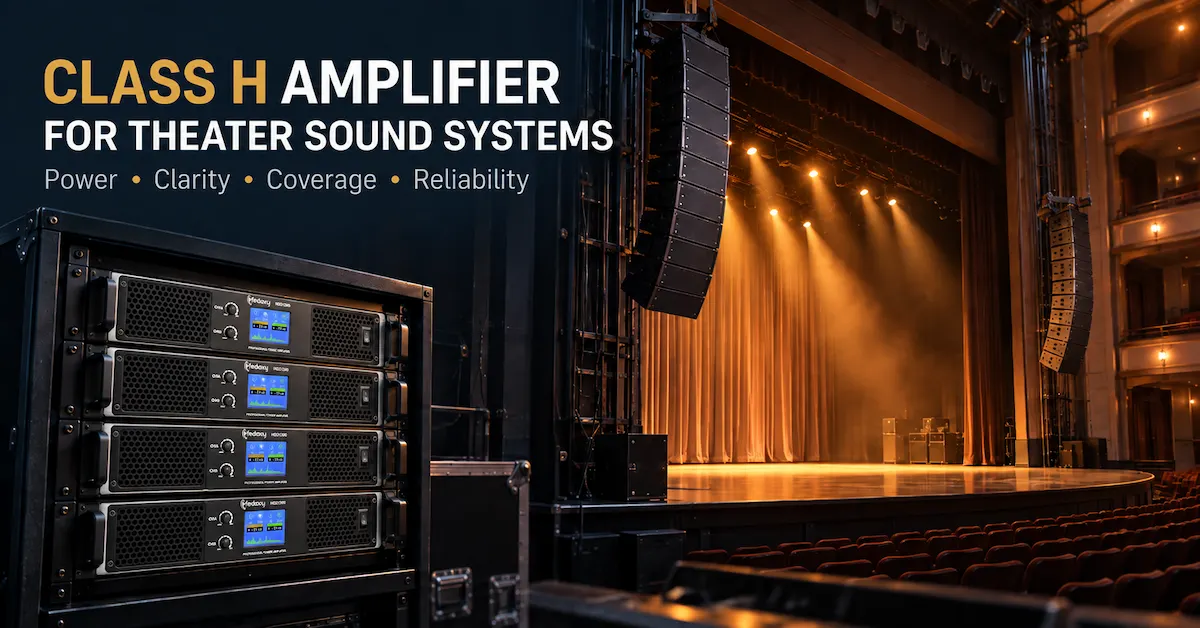
Choosing a theater amplifier is a system decision: loudspeaker load, coverage, headroom, rack space and service access must agree.
What is a Class H amplifier for theater sound systems?
A Class H amplifier uses more than one supply-rail level and changes the active rail as the waveform requires additional voltage. At modest signal levels the output stage can operate from a lower rail; during peaks it moves to a higher rail. The practical goal is to reduce unnecessary dissipation while keeping high-output capability available for music, effects and speech transients.
In a theater installation, the topology is only one part of the answer. The power supply, output devices, heat path, fan control, protection logic, input sensitivity and mechanical design determine how the amplifier behaves in a real rack. A professional Class H theater amplifier should therefore be evaluated by its complete specification and by the conditions behind the numbers.
Class H is often considered when the system needs more output than a compact background-audio amplifier can provide, yet the integrator still wants a practical rack format and a conventional analog signal path. It can serve screen channels, stage monitors, fills and subwoofers, provided the load and duty cycle remain inside the manufacturer's limits.
Who needs this type of amplifier?
Cinema and theater integrators
Integrators need repeatable channel allocation, clear protection behavior and enough headroom for a wide range of program material. Four-channel platforms can simplify a rack where mains, fills and surrounds are distributed across several zones.
Stage theaters and performing-arts venues
Shows change quickly. A Class H amplifier for stage theaters should tolerate varied speaker complements, be easy to monitor and leave room for future loudspeaker or routing changes.
Rental and touring departments
Rental teams value output per rack unit, front-to-back airflow, robust connectors, readable indicators and documentation that lets different crews deploy the same model correctly.
Distributors and OEM buyers
Distributors need a stable family, consistent data sheets, private-label options and support that helps them quote projects without guessing. OEM buyers should ask for the same verification package as a branded buyer.
The product is not automatically the right fit for every room. A small lecture room with efficient 8-ohm speakers may need less power and less rack depth. Conversely, a large cinema with long cable runs, multiple subwoofers and a high show count may require more current margin, more channels or a different topology. The load schedule decides.
Six selection factors that prevent expensive theater mistakes
1. Match power to the loudspeaker, not to the room name
Start with the loudspeaker manufacturer's continuous, program and peak ratings. Then record the nominal impedance and the minimum impedance curve if it is available. A 1,200 W amplifier figure is incomplete without the impedance and measurement conditions. Compare like with like: 8-ohm output to 8-ohm output, the same bandwidth, the same number of driven channels and the same distortion limit.
A useful design target is controlled headroom. Too little amplifier power invites clipping when an effect or musical transient arrives. Too much power is not automatically dangerous, but it demands a limiter, correct gain structure and operators who understand the system. The high power Class H amplifier for cinema should be chosen with the speaker's thermal and mechanical limits in mind, not simply because its largest number looks impressive.
2. Treat impedance as an operating condition
Nominal 8-ohm, 4-ohm and 2-ohm loads are shorthand, not a promise that the speaker remains at one resistance across all frequencies. Parallel cabinets reduce the nominal load, and cable loss can increase current demand. A low impedance Class H amplifier may publish a 2-ohm figure, but the installer still needs to check how many cabinets sit on each channel, how long the cables are, how often the system reaches high level and whether the rack can exhaust heat.
Ask the supplier for the recommended cabinet count per channel, minimum load, bridge restrictions and any duty-cycle limitations. If a specification page contains multiple values, ask for the current data sheet and a written clarification before using that value in a tender.
3. Select channel count around the zone map
Two channels are straightforward for left/right mains, a stereo pair of stage monitors or a dedicated pair of subwoofer feeds. Four channels can serve left, center, right and fills, or two main channels plus two sub channels, depending on the DSP and speaker layout. A three-channel model can be useful when a system has two equal main zones and one higher-power low-frequency zone.
Channel count is a workflow decision as well as a cost decision. More channels can reduce rack units and patching, but they also require accurate labeling and a commissioning document. Never parallel channels or bridge outputs unless the manual explicitly allows it.
4. Check thermal design, noise and rack placement
Theater equipment rooms are often warm, enclosed and difficult to access during a performance. Look for front-to-back airflow when racks are loaded in a row, intelligent fan control, unobstructed intake and an accessible filter or service path. Fan noise may be irrelevant in a remote rack but unacceptable beside a stage or a small screening room.
CS-AUDIO publishes four intelligent fans and front-to-back exhaust on several high-output Class H pages, including the FH41500 and FC41200. That is useful information, but the integrator should still calculate rack heat, measure the room's ambient temperature and leave clearance around intake and exhaust points.
5. Verify protection and recovery behavior
Power-on buffer, output DC protection, short-circuit protection and over-temperature protection protect the amplifier and the loudspeaker. Buyers should ask what the operator sees when a protection circuit acts, whether the channel recovers automatically, and whether the event is logged. A quiet protection event is not enough; the service team needs a way to diagnose the cause.
6. Decide how much DSP and control you actually need
A power amplifier does not replace a system processor. Theater installations often need crossover filters, equalization, delay, polarity control, limiters and presets for different productions. If the amplifier includes DSP, ask about access control, preset backup, firmware policy and who owns the configuration file. If processing stays in an external DSP, document the gain structure and limiter settings so another technician can reproduce the setup.
Power, impedance and measurement: how to read a data sheet
IEC 60268-3 describes methods for measuring sound-system amplifier characteristics. The important purchasing lesson is simple: a rating is meaningful only when the conditions are comparable. Ask whether the number is per channel, with all channels driven, at a stated frequency range, at a stated distortion limit and for a stated duration. Also ask whether the value is continuous, program or burst power.
| Data-sheet item | Question to ask | Why it matters in a theater |
|---|---|---|
| Output power | At which impedance, bandwidth and THD? | Prevents comparing a short burst figure with an all-channel continuous figure. |
| THD and noise | Is the test condition published? | Helps protect speech intelligibility and quiet passages. |
| Damping factor | At what frequency and load? | Provides context for low-frequency control; it is not a complete sound-quality score. |
| Minimum load | Is 2 ohms permitted on every channel? | Determines cabinet count, current demand and thermal risk. |
| Supply | Does the model match the venue's mains? | Prevents an avoidable commissioning and warranty problem. |
| Protection | What triggers it and how does it recover? | Reduces show interruption and speeds troubleshooting. |
For example, the CS-AUDIO FH41500 page publishes 4 × 1500 W at 8 ohms, 4 × 2250 W at 4 ohms and 4 × 3750 W at 2 ohms, plus 2 × 4500 W in an 8-ohm bridge configuration. It also publishes 20 Hz–20 kHz frequency response at ±0.5 dB, THD below 0.05%, signal-to-noise above 110 dB and damping factor above 500. Those figures help an integrator shortlist the model; they do not remove the need to verify the load schedule and current revision.
FC41200 is a useful example of why written confirmation matters. Its headline advertises 4 × 1200 W at 8 ohms, 4 × 1500 W at 4 ohms and 4 × 2500 W at 2 ohms, while a detailed parameter table on the page shows different 4-ohm and 2-ohm values. Treat the discrepancy as an RFQ checkpoint. Ask CS-AUDIO to identify the correct revision for the intended market, voltage and test method before those numbers enter a tender.
Two-channel, three-channel or four-channel: a practical theater matrix
| System need | Typical channel plan | What to prioritize |
|---|---|---|
| Simple left/right stage system | 2-channel amplifier | Headroom, quiet fan profile, easy gain access and 8-ohm/4-ohm flexibility. |
| Screen L/C/R with front fills | 4-channel amplifier | Four independent channels, clear labeling and rack heat calculation. |
| Main plus subwoofer zones | 2 or 4 channels | Current capability, limiter coordination and low-frequency cable management. |
| Surround-heavy cinema | Several 4-channel units | Consistent gain, repeatable presets and service spares. |
| Mixed production and speech events | 2/4-channel family | Fast repatching, documented scenes and enough clean headroom for effects. |
A multi-channel theater power amplifier is valuable when it reduces the total number of chassis without forcing unrelated zones to share a limiter or a service action. Keep critical screen channels on clearly identified outputs, and reserve a channel map that can be understood by a visiting engineer at 2 a.m. during a changeover.
CS-AUDIO Class H models: where each platform can fit
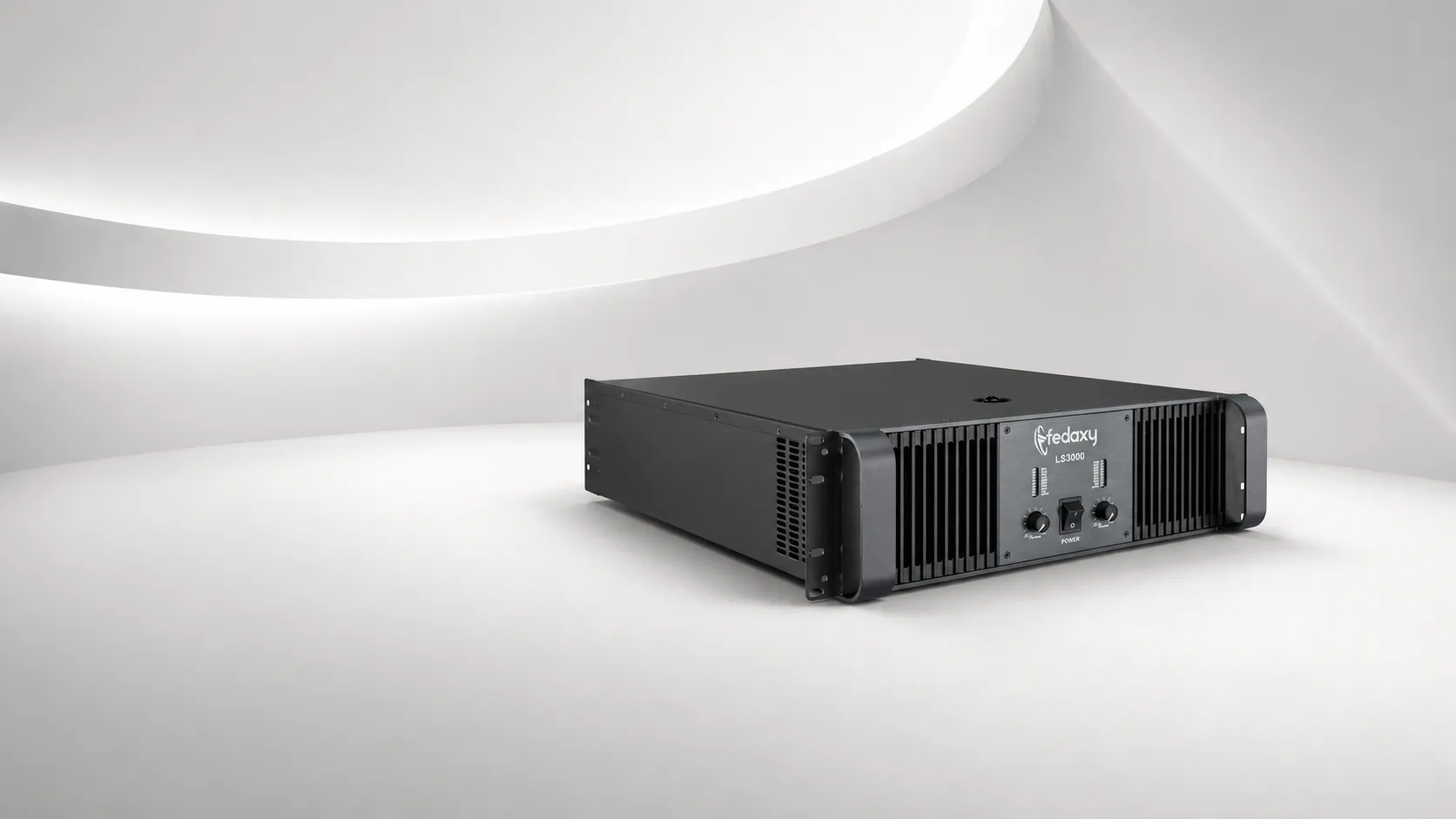
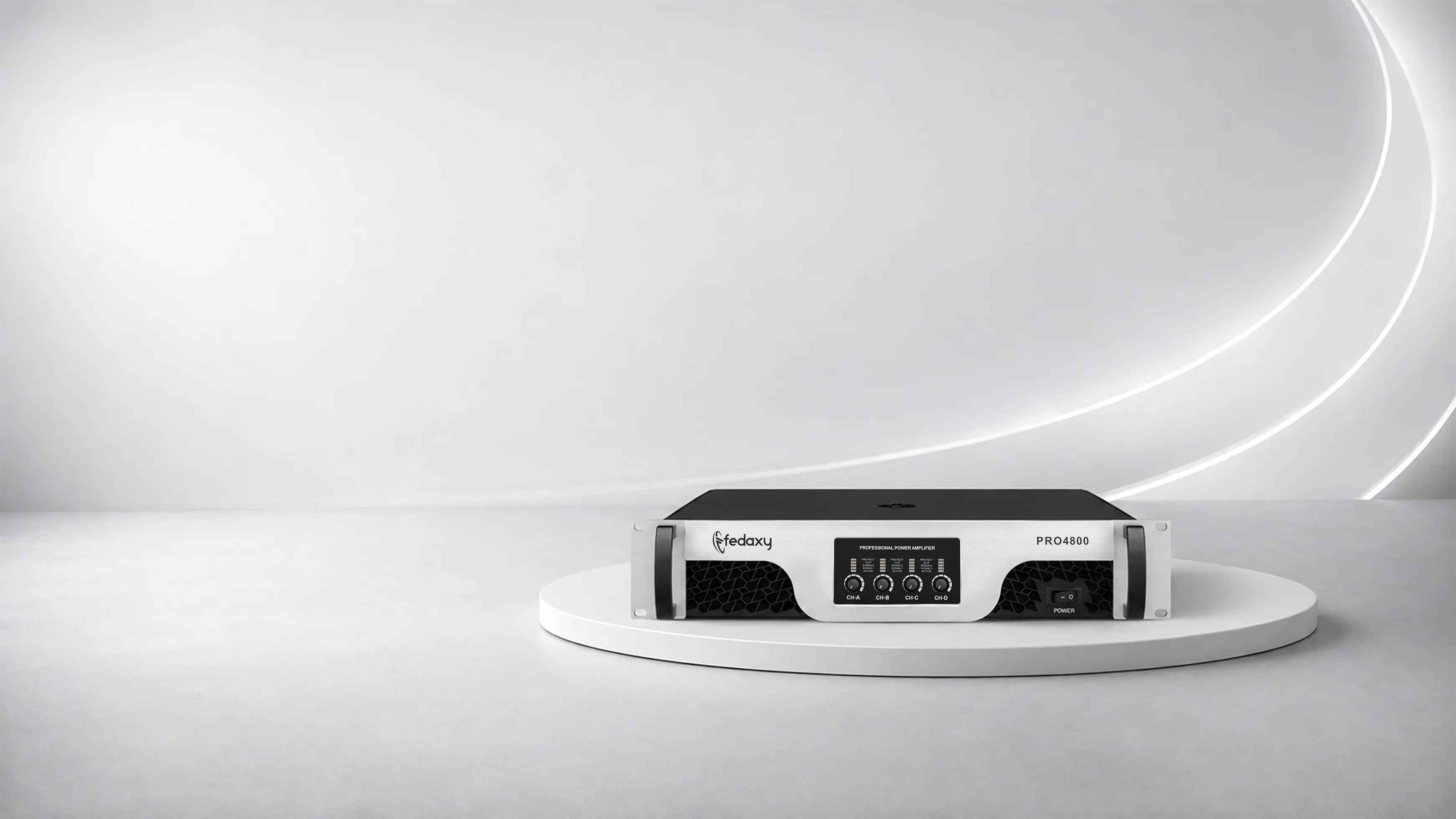
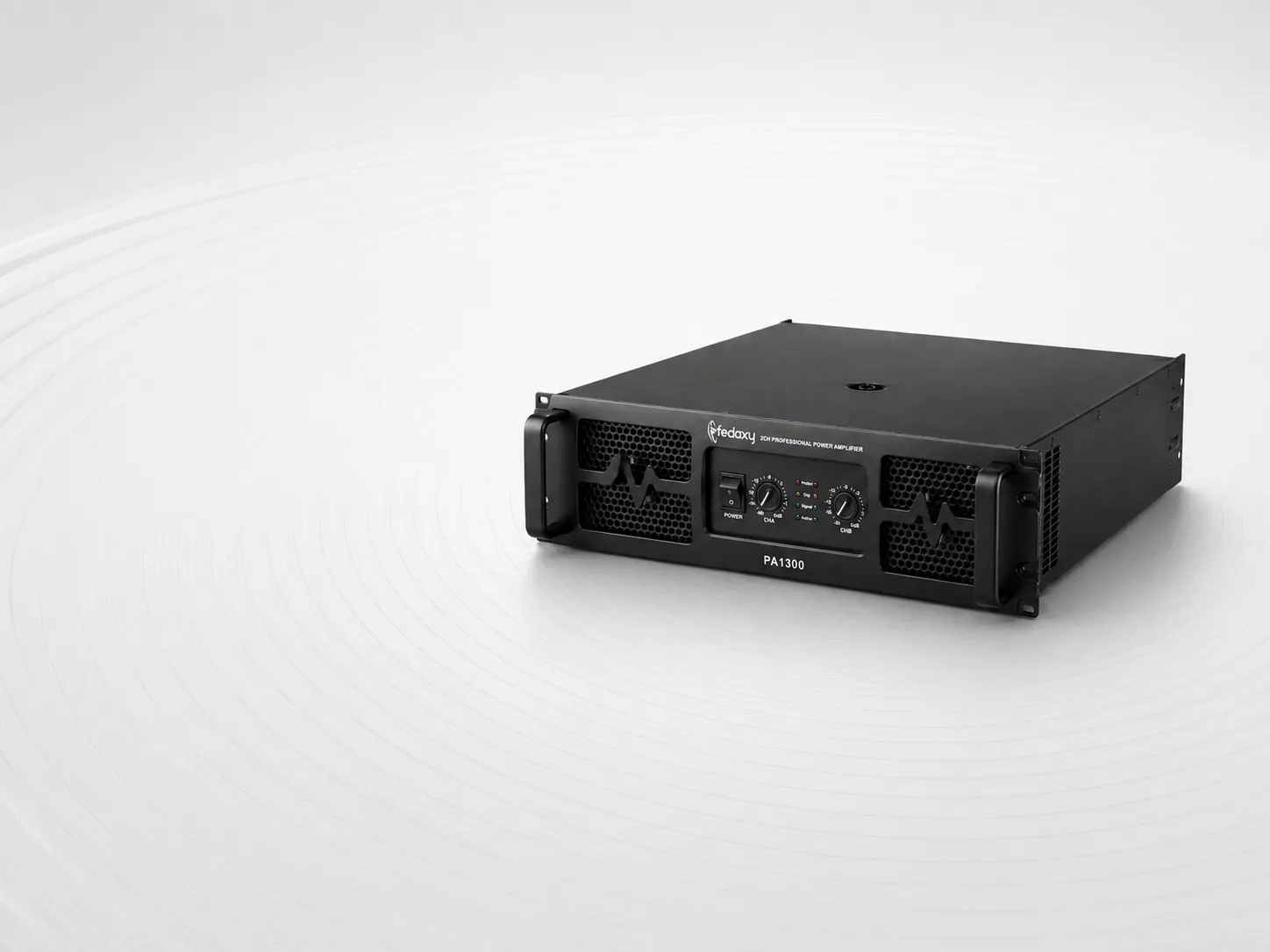
The following table is a starting point for an RFQ, not a substitute for the exact data sheet. CS-AUDIO's public catalog lists Class H families from compact two-channel models to three-unit, high-output four-channel platforms. Link each shortlisted model to its current page and ask for a written load recommendation.
| Model | Published configuration | Useful theater role | Product link |
|---|---|---|---|
| HD21200 | 2-channel, 2 × 1200 W family | Left/right mains or dedicated subwoofer pair where a two-channel chassis is preferred. | View HD21200 |
| HD41200 | 4-channel, 4 × 1200 W family | Screen channels and fills, or compact multi-zone installations. | View HD41200 |
| FH21500 | 3U, 2-channel, 2 × 1500 W class | High-output mains, monitors or subwoofer duties with two independent feeds. | View FH21500 |
| FH41500 | 3U, 4-channel, 4 × 1500 W at 8 ohms published | Large screen rooms, stage theaters and high-output distributed systems. | View FH41500 |
| FC41200 | 4-channel, 4 × 1200 W headline at 8 ohms | Concert, rental and fixed-installation projects; confirm detailed 4-ohm/2-ohm data. | View FC41200 |
| HT42000 | 3U, 4-channel, 4 × 2000 W class | Very high-output mains or subwoofer zones where the current data sheet supports the design. | View HT42000 |
The FH41500 is a sensible comparison anchor because its page exposes the power, bridge, frequency, THD, S/N, damping, cooling and protection information needed for an initial engineering review. HT42000 belongs in a high-output conversation, but the integrator should request the current English data sheet, confirm the exact HT42000 revision and check that the electrical service and rack heat budget can support it.
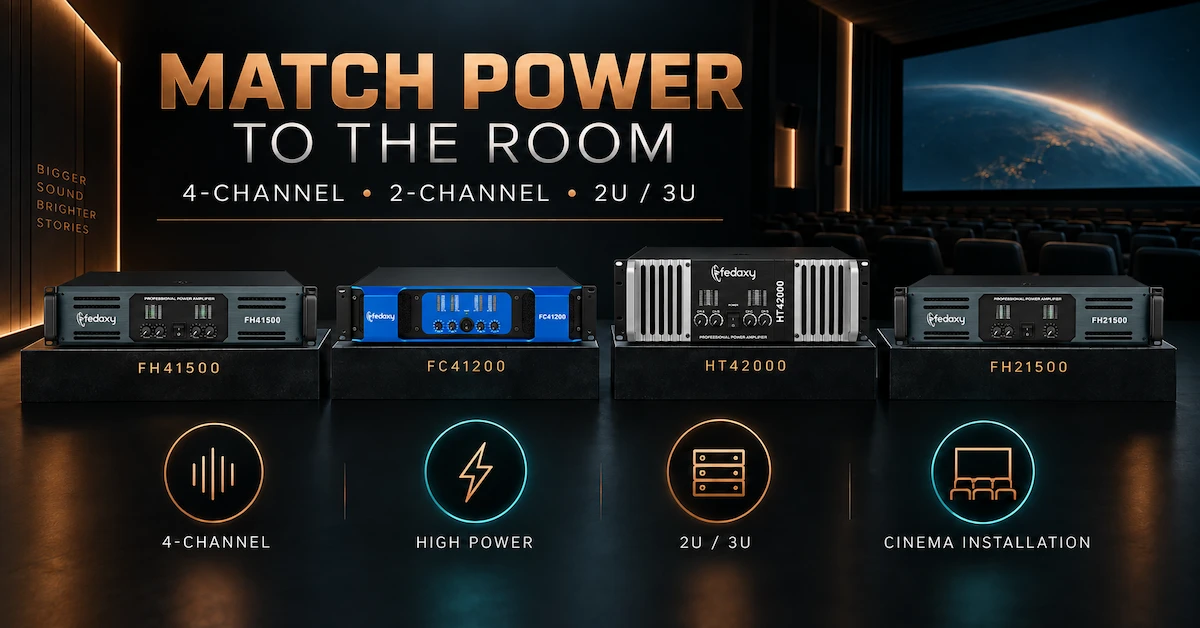
Use the model family to narrow the shortlist, then verify the exact load, voltage and revision in writing.
Application examples: turning a room plan into an amplifier plan
Example A: 800-seat proscenium theater
Suppose a proscenium room has left, center and right screen clusters, two front-fill circuits, four surround circuits and two subwoofer arrays. The first pass is a channel map, not a shopping list. The integrator can group equal surrounds on dedicated channels, keep the center channel independently protected, and assign the low-frequency arrays to outputs with suitable current capability. A four-channel chassis may serve one screen group plus fills; several identical units make spares and presets easier to manage.
Before approving a professional power amplifier for theater sound , check whether the loudspeaker manufacturer expects a particular voltage gain, whether the processor can limit each zone independently and whether the equipment room can exhaust the combined heat. A compact rack that looks efficient on paper can become a service problem if every amplifier is at the top of its duty cycle.
Example B: cinema with low-impedance subwoofers
Low-frequency cabinets are often paralleled. That can create a 4-ohm or 2-ohm nominal load, depending on the cabinet count and wiring. A high-current amplifier may be appropriate, but the installer should confirm that the chosen channel can sustain the expected level, that the processor's limiter is aligned to the cabinet's thermal rating and that the mains circuit is sized for real operating conditions.
Example C: touring production visiting a theater
A touring package values predictable connectors, readable indicators, front-to-back cooling and a documented preset. The host theater may have a different mains voltage or rack depth. The RFQ should include transportation, local power, rack rails, cable looms, backup units and a handover file. A model that is ideal for a fixed room may be less convenient for repeated loading if its gross weight and packing size are not considered.
Commissioning workflow: measure before the first public show
Commissioning is where a good amplifier choice becomes a reliable system. Use a written checklist and keep the final values with the venue's technical documentation.
- Confirm the paperwork: match model, serial number, voltage, connector pinout, manual revision and current data sheet.
- Inspect the rack: verify rail support, airflow clearance, cable bend radius, grounding and service access.
- Map every channel: label processor output, amplifier input, amplifier output, loudspeaker zone and limiter preset.
- Measure the load: check wiring polarity and expected impedance before applying program material.
- Set gain structure: use the processor and amplifier sensitivity consistently; avoid compensating for a wrong preset with excessive gain.
- Set crossover and delay: align mains, fills, surrounds and subs at the listening position, not only at the rack.
- Test protection: follow the manual's safe procedure for over-temperature, short-circuit and output DC checks.
- Run a show-level rehearsal: observe temperature, fan behavior, limiter activity and any channel imbalance.
- Document handover: save the final preset, channel map, measured values, maintenance interval and emergency bypass plan.
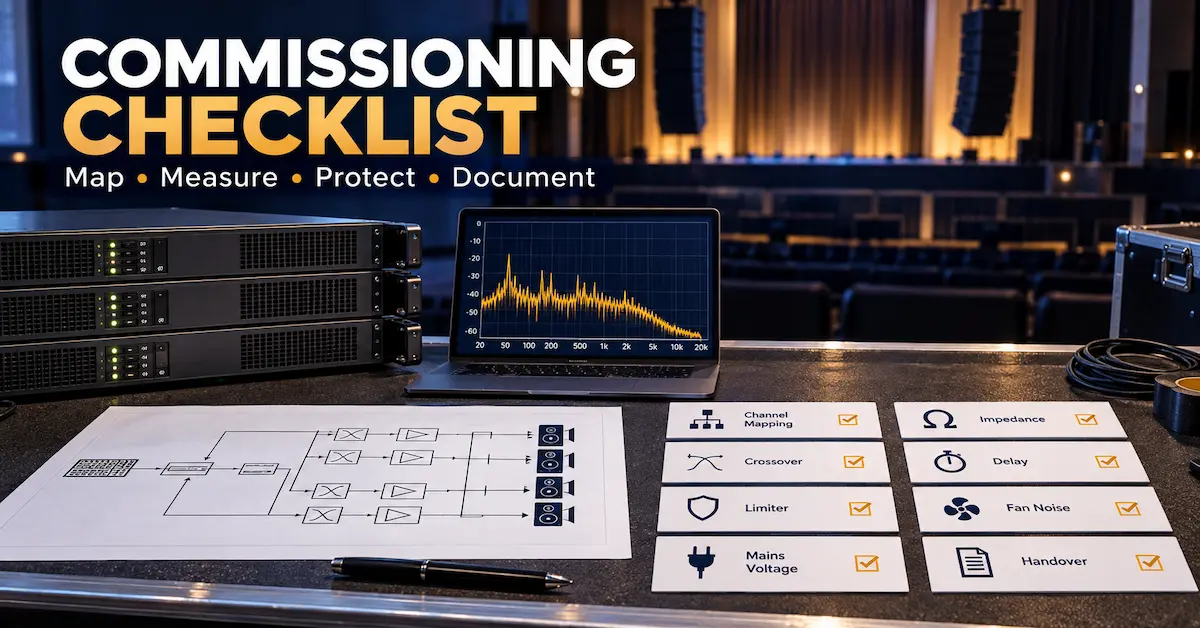
A handover sheet turns technical knowledge into a repeatable operating routine.
How to evaluate a theater audio amplifier manufacturer
A supplier can quote a large number quickly. A manufacturer that is ready for professional work can explain how the number was measured, which conditions apply and what happens after shipment. When comparing a theater audio amplifier manufacturer , ask for evidence in five areas.
- Engineering capability: Can the team review your loudspeaker schedule, channel map, voltage and rack constraints? Do they distinguish a recommendation from a guarantee?
- Production and QC: What are the incoming, assembly, performance, aging and final inspection steps? CS-AUDIO publicly describes five QC inspections and an eight-hour aging test; confirm how those steps apply to the exact model and order.
- Documentation: Are manuals, drawings, test conditions, packing dimensions and certificates available? Ask for a revision-controlled PDF, not a screenshot copied from an old listing.
- Customization: Can the factory support OEM/ODM panel labeling, packaging, voltage, connectors or DSP presets without changing safety-critical design controls?
- After-sales: What is the warranty scope, spare-parts path, fault-report process and expected response time for a distributor or venue outside China?
CS-AUDIO states that it has more than 15 years of R&D and production experience, sells Class D, Class TD, Class H and Class AB families, and supports OEM/ODM/OBM/OIM/SKD cooperation. The same public material references ISO9001, CE, RoHS and CB claims, a three-year warranty and exports to more than 100 countries. Treat these as CS-AUDIO's published company claims and verify the certificate, warranty and model scope for the transaction you are planning.
IEC 62368-1 is a useful safety reference for audio/video equipment. It does not certify sound quality, and a general company statement should not be treated as proof that every model carries the same approval. Put certificate numbers, market, model and expiry into the purchase file.
OEM, private label and project customization
OEM buyers often start with a request for a logo, but a theater project may need more: a particular input connector, a local mains variant, a different front-panel legend, a locked DSP preset, a shipping carton that fits a distributor's warehouse or a spare-parts list for a regional service team. Clarify which changes are cosmetic and which require electrical revalidation.
Use a staged approval process. First approve the electrical specification and load limits. Next approve a drawing or sample for panel, connector and label details. Then approve a production sample, packing test and final inspection plan. Ask which changes trigger a new safety or EMC review. Keep the approved revision attached to the purchase order so a later batch is not built from an informal message.
For a private-label professional Class H theater amplifier , request a neutral test report that still identifies the underlying model, power conditions, protection behavior and serial range. This gives a distributor something credible to share with an integrator while protecting the manufacturer's engineering traceability.
Cost and procurement risks buyers should price before approval
The amplifier price is only one line in a theater budget. Include rack hardware, cable looms, DSP programming, freight weight, insurance, customs, electrical work, spare units, local service and commissioning time. A 3U amplifier with higher output may reduce chassis count but increase rack weight and heat. A four-channel model may save space but require a more careful channel map and a spare strategy.
Ask for sample pricing, MOQ, lead time, packing size, gross weight, payment terms and Incoterms in the same RFQ. If a figure is not confirmed, mark it as “to be confirmed” rather than copying a generic website promise into a customer quote. The safest comparison sheet contains one column for the supplier's published value and another for the value confirmed for the project.
| RFQ field | Buyer should provide | Supplier should return |
|---|---|---|
| Venue | Cinema, stage theater, touring or multi-use hall | Recommended platform and application limits |
| Load | Speaker model, quantity, nominal/minimum impedance | Channel count, cabinet count per channel and wiring notes |
| Power | Continuous/program target and headroom preference | Power table with conditions and current revision |
| Rack | Available U height, depth, airflow and ambient temperature | Chassis dimensions, airflow direction, heat and service clearance |
| Control | DSP, Dante, analog input or external processor | Compatibility, preset method and backup workflow |
| Commercial | Quantity, destination, target date and branding | MOQ, sample, lead time, packing, warranty and spare-parts terms |
What to send for a fast, accurate quotation
The shortest path to a useful recommendation is a complete brief. Attach the venue plan if available, then send:
- venue type, audience capacity and whether the system is fixed or touring;
- speaker brand, model, quantity, nominal impedance and continuous/program power;
- zone list: L/C/R, fills, surrounds, subs, monitors, lobby and assistive listening;
- desired channel allocation, bridge requirements and any 2-ohm operation;
- mains voltage, frequency, rack height, maximum depth and ventilation conditions;
- DSP, Dante, remote monitoring, connector and preset requirements;
- delivery country, target quantity, sample need, private-label scope and target date.
With those details, CS-AUDIO's engineering and sales teams can recommend a platform instead of sending a generic catalog. The recommendation should state the model, expected load, output condition, channel map, assumptions and items that still need confirmation.
FAQ: Class H theater amplifier buying questions
- What is the main advantage of Class H in a theater?
- Class H can provide high output while changing supply rails with signal demand, which may reduce unnecessary dissipation compared with a permanently high rail. The complete amplifier design, duty cycle and cooling still matter more than the topology label alone.
- How do I size an amplifier for a cinema subwoofer?
- Use the subwoofer maker's continuous and program ratings, cabinet count, impedance and limiter recommendation. Confirm the amplifier's tested output at that load, the expected mains current and the rack's ability to remove heat.
- Is four-channel always better than two-channel?
- No. Four channels are useful when the room has several independent zones or when rack density matters. Two channels can be simpler for a stereo pair, a subwoofer pair or a system that already has a clear external processing plan.
- Can I use a Class H amplifier beside the audience?
- Only if its fan noise, airflow and electrical installation are acceptable for the room. A remote technical rack is usually easier. If the amplifier must be near the audience, measure noise during quiet passages and leave proper service clearance.
- Should the theater amplifier include DSP?
- It depends on the control architecture. Built-in DSP can simplify a self-contained system, while an external processor may be preferred for a cinema processor, touring workflow or a venue with multiple control layers. Decide who will own presets and backups.
- How should a buyer handle conflicting product-page figures?
- Do not average them or choose the larger number. Capture the URL, ask for the current data sheet, request the test condition and obtain written confirmation for the exact model, voltage and market.
- What warranty details matter?
- Ask what is covered, for how long, where service is performed, who pays freight for a fault, which parts are considered consumable and how a distributor handles an urgent show-related failure.
- What makes a supplier a reliable long-term partner?
- Clear data, traceable revisions, realistic recommendations, repeatable QC, accessible spares and a documented response process. A supplier that asks about the load schedule is usually more useful than one that only repeats a wattage headline.
Conclusion: choose the system match, then choose the model
The best Class H amplifier for theater sound systems is the one whose output, impedance range, channels, cooling, protection and service plan match the loudspeaker schedule and the venue's operating reality. Start with the zone map. Compare ratings under the same conditions. Confirm the rack and mains. Ask for the current data sheet when figures disagree. Then put the assumptions in writing.
CS-AUDIO's Class H catalog gives integrators several starting points, from two-channel platforms to high-output four-channel models such as FH41500 and HT42000. The efficient next step is not to guess from a product headline. Send the venue, speaker, impedance, quantity, voltage, channel and branding details, and request a written recommendation that your team can test, quote and support.